Nov. 12, 2024
Elizabeth Sparkle is not a Woman of Substance
by Marcello Cortese
Christine Tamalet
When we think of the phrase “a woman of substance,” our reference point might not immediately be Coralie Fargeat, but considering what the french filmmaker and screenwriter has delivered to us in her newest feature film, this phrase surely adopts an entirely different definition.
Fargeat came into public acclaim in 2017, receiving adoration across the board for her directorial debut Revenge: a film which follows a woman who embarks on a path of bloodthirsty vengeance after being attacked and left for dead. It is a brutal depiction of desperation, female rage, cruel irony and satisfaction. Fargeat’s newest film, entitled The Substance, discusses very similar themes, but takes a sharp turn away from the naturalistic hellscape of a desert and instead brings the audience into the painfully isolated life of a woman forgotten and discarded by Hollywood. But, unlike Fargeat’s bold, brilliant, and brutal genius of Revenge, she fails catastrophically with this new project.
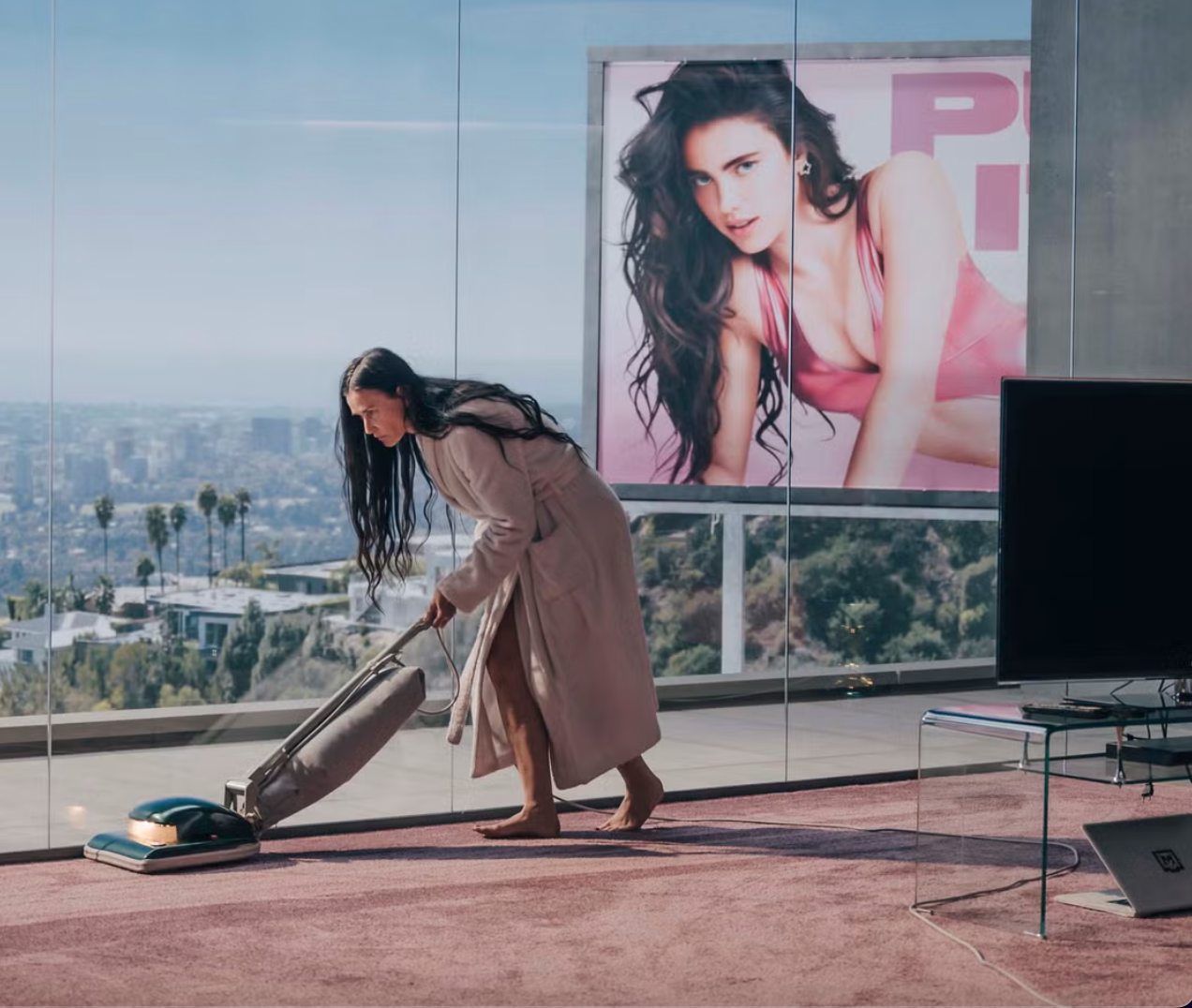
The Substance follows Elizabeth Sparkle—a jazzercise icon a là Jane Fonda of 80s Hollywood—who has outgrown her youthful usefulness in the eyes of her studio and audience alike, and ends up on the outs almost as soon as the film begins. Annexed and desperate, Elizabeth is given the mysterious opportunity to try a new dna-altering drug that creates the “perfect you”, which leads very quickly to a body-horror fiasco of monstrous proportions.
The problem here is certainly not Demi Moore’s performance as Elizabeth Sparkle (for which she undoubtedly will receive an Oscar nomination, at least), nor is it Margaret Qualley’s devilishly unsettling portrayal of Sue—Sparkle’s “perfect” alter-ego that usurps her former position of spotlighted fame. It is also not Dennis Quaid’s astute conviction that goes into the flawlessly misogynistic caricature that is Harvey (Sparkle’s manager/producer). I mean, for that shrimp scene alone, he certainly earned his chops.
No, the fault lies in Fargeat’s own hamartia: the screenplay. A central theme of the film is mitosis, which reappears incrementally in the uncertainty of whether Elizabeth and Sue are one or are merely competing with each other for complete liberation. But the thing is, they’re tethered by biology. The first two acts of the film pristinely establish the true horror and anguish that Fargeat attempts to flesh out: female loneliness, male hubris, sexual double standards and the shock of the beauty industry. The first technical wobble, however, comes in the film’s ridiculous expectation that the audience should believe Margaret Qualley is fully capable of knocking down an entire wall and installing a secret door. She’s able to do this herself? And in under five days?
The pace from there quickly picks up and dives right off the deep end into a series of genuine shocks that you most definitely will not be ready for. A kitchen scene where Moore prepares a feast of impossible proportions as though she were the witch from Hansel and Gretel. An epic showdown that lasts far longer than anatomically possible (and seriously, Ms. Fargeat, if you really wanted us to believe that was possible, she would have only pushed in that syringe half-way at most). And, of course, the third and final act that leaves behind any semblance of what the film formerly was, so much so that you could exit the theater 30 minutes early and lose no satisfaction. Everything after that penultimate tonal shift proves that Fargeat established one of the most brilliant contemporary commentaries on beauty and aging standards, and then just ditched it all for the sake of cheap Hollywood gore.
The irony is that The Substance does, in a way, live up to its proposed message. The navel of the film comes about halfway through in the form of a rather poignant scene that highlights Sparkle’s self loathing as she repeatedly makes herself up in preparation to go out to dinner. Elizabeth spends close to ten minutes on screen doing this, giving us a visceral glimpse into the greater psychology behind her character. It’s too banal for us to say, “Oh, she was famous and fame-hungry and extreme narcissism is what her character will always be fueled by” because Fargeat proves that this is not the full truth. Sparkle has “expired” in the eyes of everyone around her, and so in a desperate attempt to feel normal again, she accepts an invitation to have a nice, simple dinner with a rather unappealing man. Because she’s lonely! She’s not a woman who simply wants undying fame. She wants acknowledgement. From absolutely anyone! She craves fundamental validation: a very human thing, no?
So what was up with that complete deterioration of this inner message? It is clear that the film decides to throw out its own credibility with one final smorgasbord of carnage and spectacle, but why? There are (not so subtle) references to Carrie and The Fly, calling upon older Hollywood classics to justify Fargeat’s choices, but quite frankly there hasn’t been a proper justification for so much fake blood in any film since It: Chapter Two.
It may be easy, for these reasons, to simply dismiss this lack of stamina as a “fun and camp” choice, which is what Fargeat wishes for the audience to conclude, but the film is not simply so. It is heart wrenching and macabre, sewn together with touches of psychological romance. In a particular moment near the end, as “Elizasue” reapplies her pair of diamond earrings at her vanity, Bernard Herrmann’s Scene d’amour from Hitchcock’s Vertigo plays faintly in the background. And anyone who has seen The Goonies cannot have ignored the allusion to Sloth. Fargeat’s inability to choose between severity and caricature goes beyond anything satirical, which is only worsened by these hollow re-adaptations of former cinematic greatness. But I am here to say to you, Ms. Fargeat, that for a film whose central mantra is “Remember you are one”, you most certainly, cannes-not have it both ways.