The Little Jack that Klute Captured
by Marcello Cortese
It was a curious thing: the notion of a pitcher plant as a pulpit.
Was it a subversive euphemism for humankind’s fascination with constant compartmentalization? Or a Romantic take on the innate divinity of nature, of the podium on which all life sprouts from? It was even curiouser to consider where the “Jack” of it all was. Was it a fly trapped within one of the plant's wells? Was it a spider spinning around one of the leaves, just out of sight of the shot? Or was “Jack” perhaps the cameraman, behind the lens, and the pulpit was the photograph itself?
If you have had the pleasure of viewing Jeanette Klute’s “Jack in the Pulpit,” which is currently on display at the International Center of Photography in the Bowery, you may have strained to answer questions similar to these. And you’d be forgiven for being, like me, foolish enough to realize later on that a Jack-in-the-pulpit is no more a cheeky metaphor than it is a pitcher plant.
The peculiar flower, which bears green and red shades with white stripes not unlike a zebra’s, is relatively common throughout New England and, in Klute’s specific case, the Finger Lakes of New York. It is there that she used to photograph native flora and fauna throughout the nineteen-forties and fifties while she worked at Eastman Kodak. Her photographic expertise began to develop (pun intended) when she was hired in 1938, when she was exposed to the other side of the camera as a lab technician. By 1945, Klute had become the head of the Visual Research Studio at Kodak, specializing in color photography via Kodachrome. By the 1950s, she was a renowned name in the respect of photography and its mechanics.
“Jack in the Pulpit” bears no frills. It has no ornate frame, no unnecessary advertisements about it. Nor does it exemplify a pretentiousness in its mastery at capturing, with such mouthwatering clarity, every star of dust in the sunlight or the peek of the moss at the bottom of the photo. It simply resides. Amidst a sea of black and white photographs—including an Avedon—it remains itself. The mastery, too, of a beauty such as “Jack” lies in Klute’s pioneering accomplishments in advancing Kodak’s reputation for color processing photography. The photo is impressive and breathtaking for today’s standards, of course, but to have successfully pulled craft like that off in the 50s? Incredible.
So what’s the point? Is “Jack” just a splendid gimmick that found its way to the public through a series of handoffs? Is it Klute’s chef d’oeuvre: a seamless embodiment of retroism, technological advancement, and philosophical Romance? Or could it be that it is, just as its face value might whisper to any viewer, a genuinely good photograph? To say it’s one or the other is too close for comfort, and it need not be any conclusion.
To stand in front of “Jack in the Pulpit” is to be reminded of all these things and to have solid, evidentiary proof that a camera was able to capture something truly resplendent, just as the naked eye would. You’ll stand before it and feel a warmer thing inside you and say to yourself that you love it regardless.
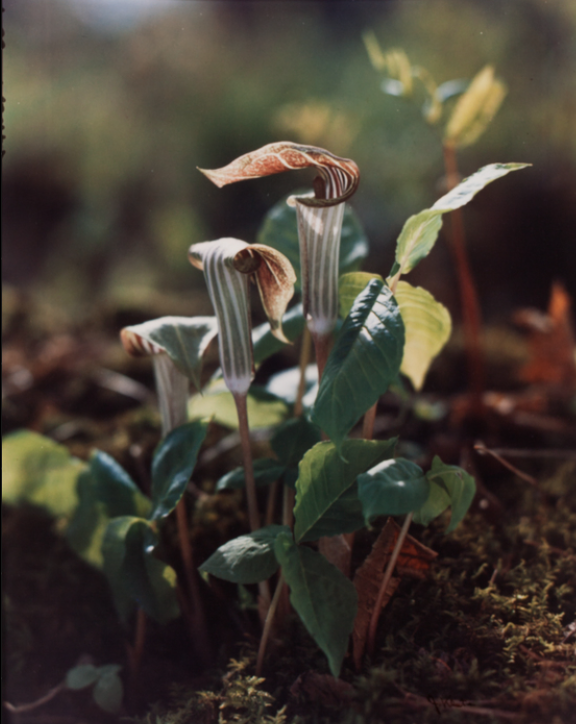
Jack in the Pulpit, Jeanette Klute. 1950. Photo-dye transfer.
Courtesy of ICP.com
Nov. 1, 2024