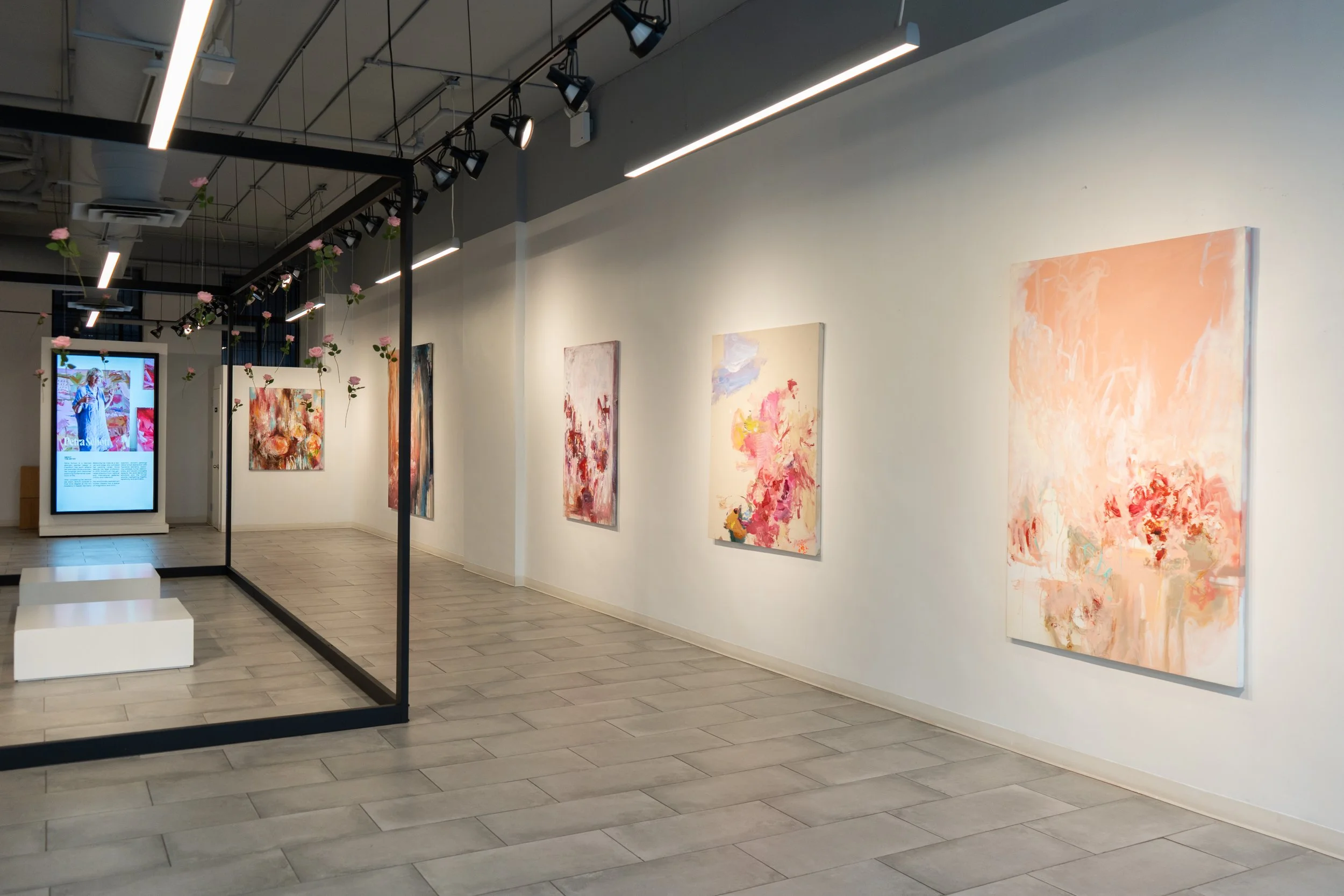
Bearing the Unwarranted Halo: “Roses of Heliogabalus & The Opulence of Ruin” Consumes Beauty and Spits it Back Out
by Marcello Cortese
While it may be quite difficult to actually engorge oneself on beauty, it is not impossible.
Aidana Bergali’s abstract exhibition “Roses of Heliogabalus & The Opulence of Ruin” proves this to be both a possibility and, in some cases, an extreme. The exhibition opened on Saturday at Mriya Gallery in Tribeca. Since its founding in 2023, Mriya has been recognized as the first Ukrainian gallery in New York. Self-branded as a “socially responsible” institution, the gallery emphasizes young and displaced artists and artwork, with a focus on the Ukrainian perspective. A great deal of their exhibitions are interested in the suspension of order and chaos, and include a smattering of deconstructive, jarring, and technically innovative creations of mixed media, canvas, and even sculpture.
Amidst the ongoing tumult in Ukraine, the messages that charge through are ones of chaos, political injustice, and sparsity. Artists at Mriya reflect these conditions through a great deal of concrete, post-apocalyptic sculpture, melancholic canvases and linens stained with materials suggested to not be paint. The body, too, comes into play, broken and reformed in tandem with technology in order to form a sense of “techno-uncanny” conversation with the space itself.
Bergali’s exhibition is nothing of this sort. As her curatorial debut, she decided to approach Mriya’s mission through the opposite lens: Beauty and Excess. Themed after Lawrence Alma-Tadema’s 1888 painting of the same name, “Roses of Heliogabalus” as a collection is interested in the political, the uncanny, and the grotesque as a byproduct of serendipity and tradition. Featuring six artists (Gianna Tesone, Michael Alexander Campbell, Nina Hunter, Shantaye McMorrow, Kevin Watson, and Petra Schott), “Roses” is an investment in the violence of form, medium, and narrative itself. In tandem with addressing the political repercussions of public spectacle, the works bring classical allusion, symbolism, and the pertinence of beautiful injustice into the contemporary sphere.
Post opening, I had the pleasure of sitting down with Bergali to get a deeper insight into the fraying threads of the “Roses” narratives:
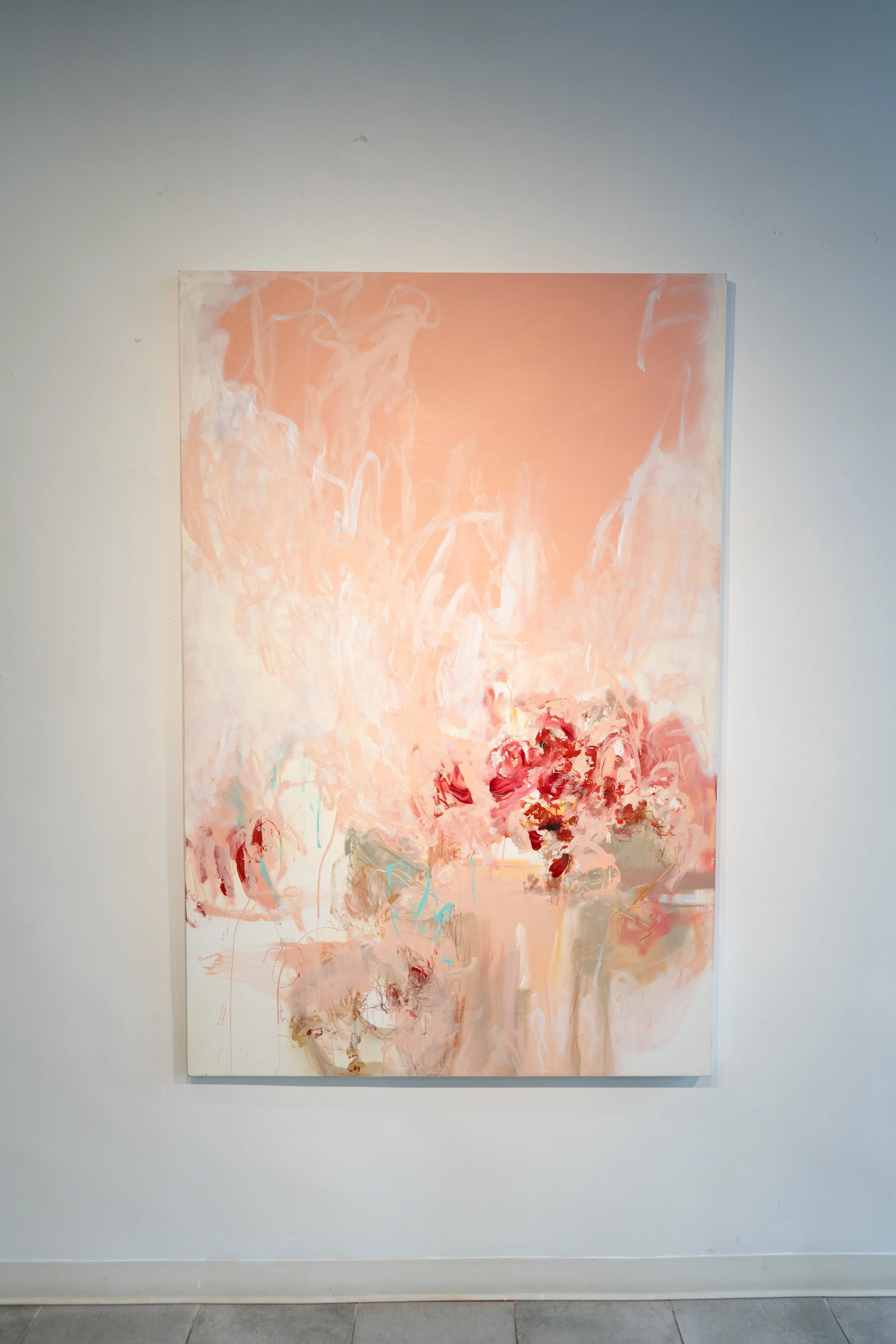
When Essence Unfolds, 2024. Gianna Tesone. Acrylic, spray Paint, oil pastel on canvas.
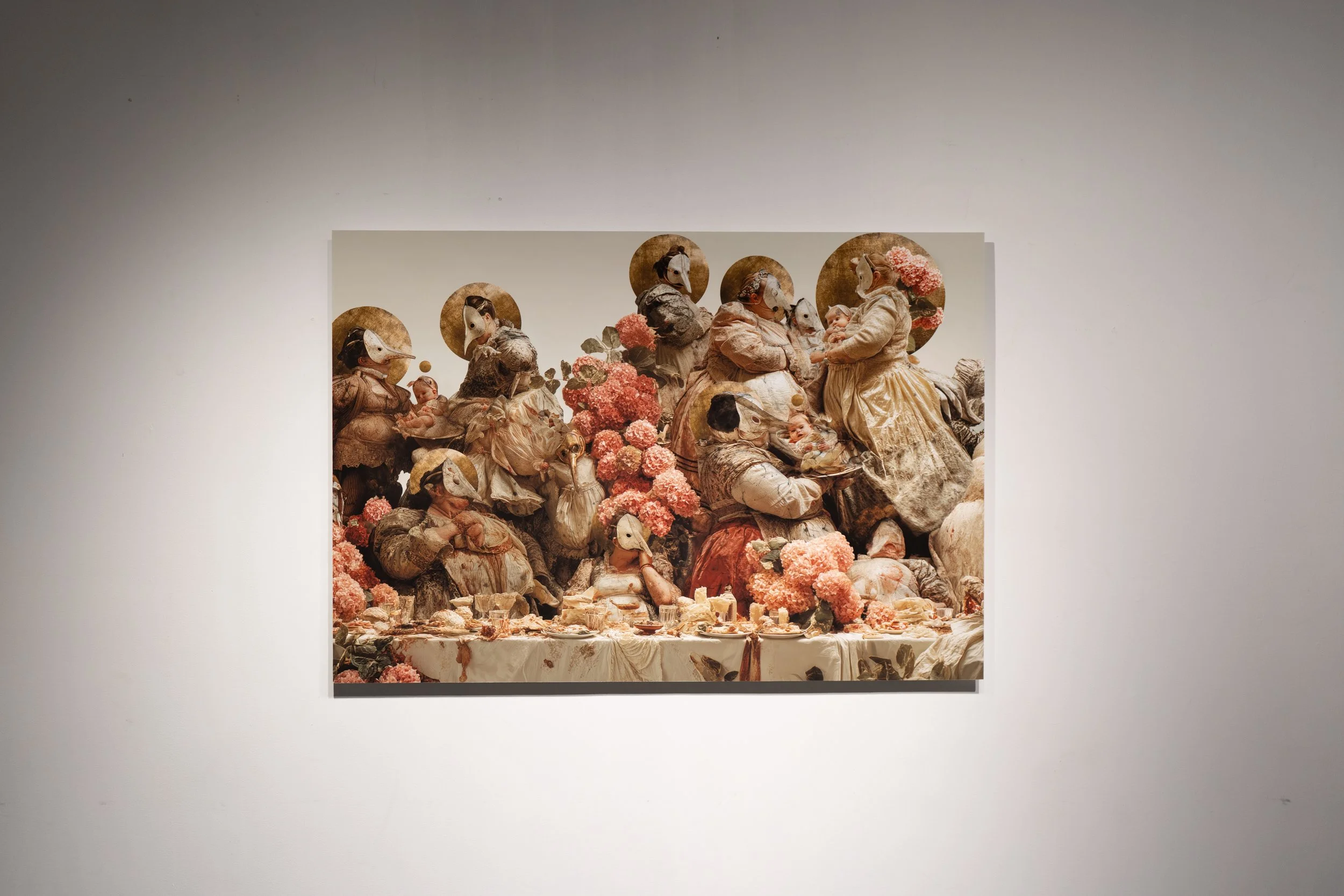
Gifts (Title Page), 2025. Kevin Watson. Mixed media collage.
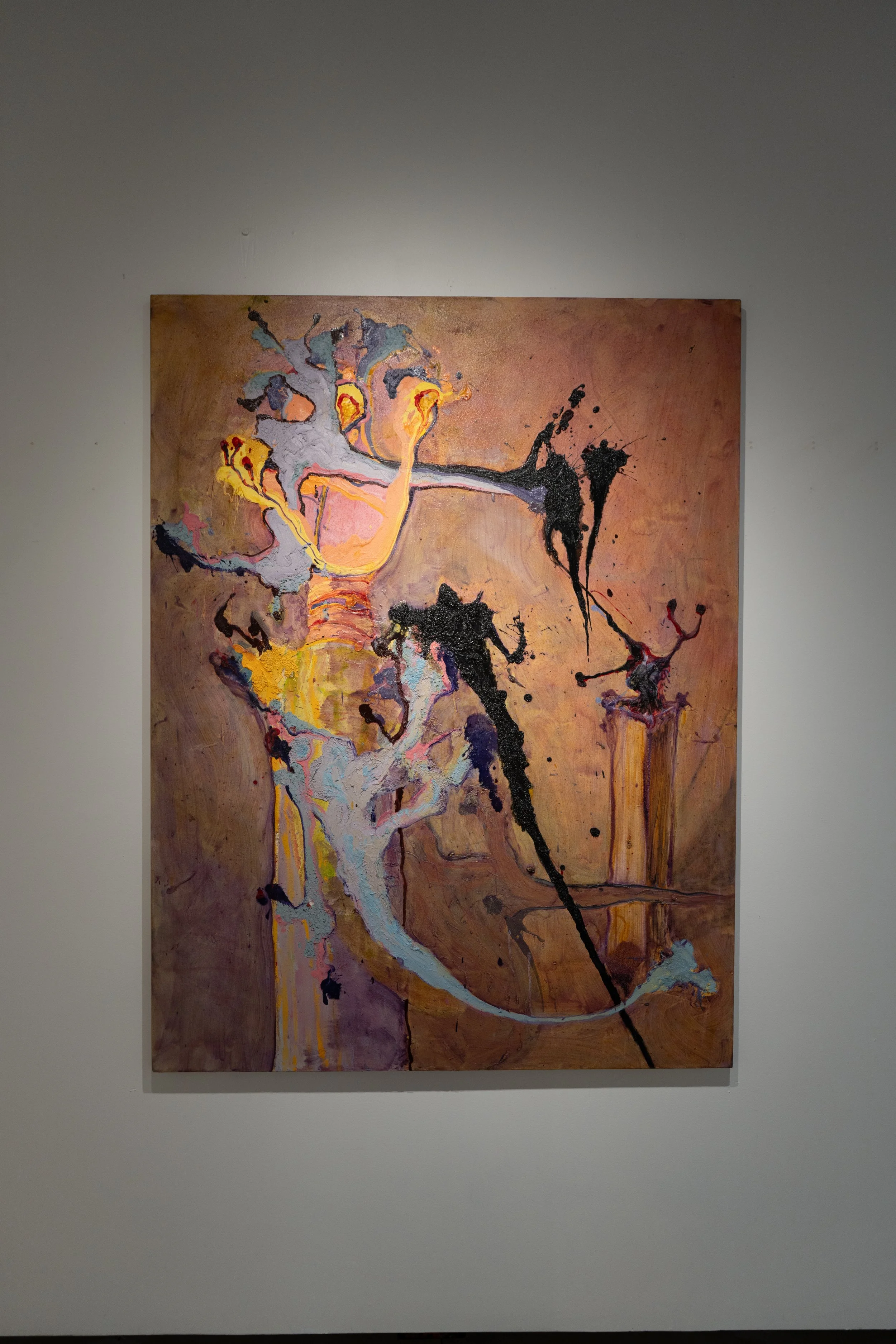
How to Worship 4, 2025. Michael Alexander Campbell. Oil on canvas.
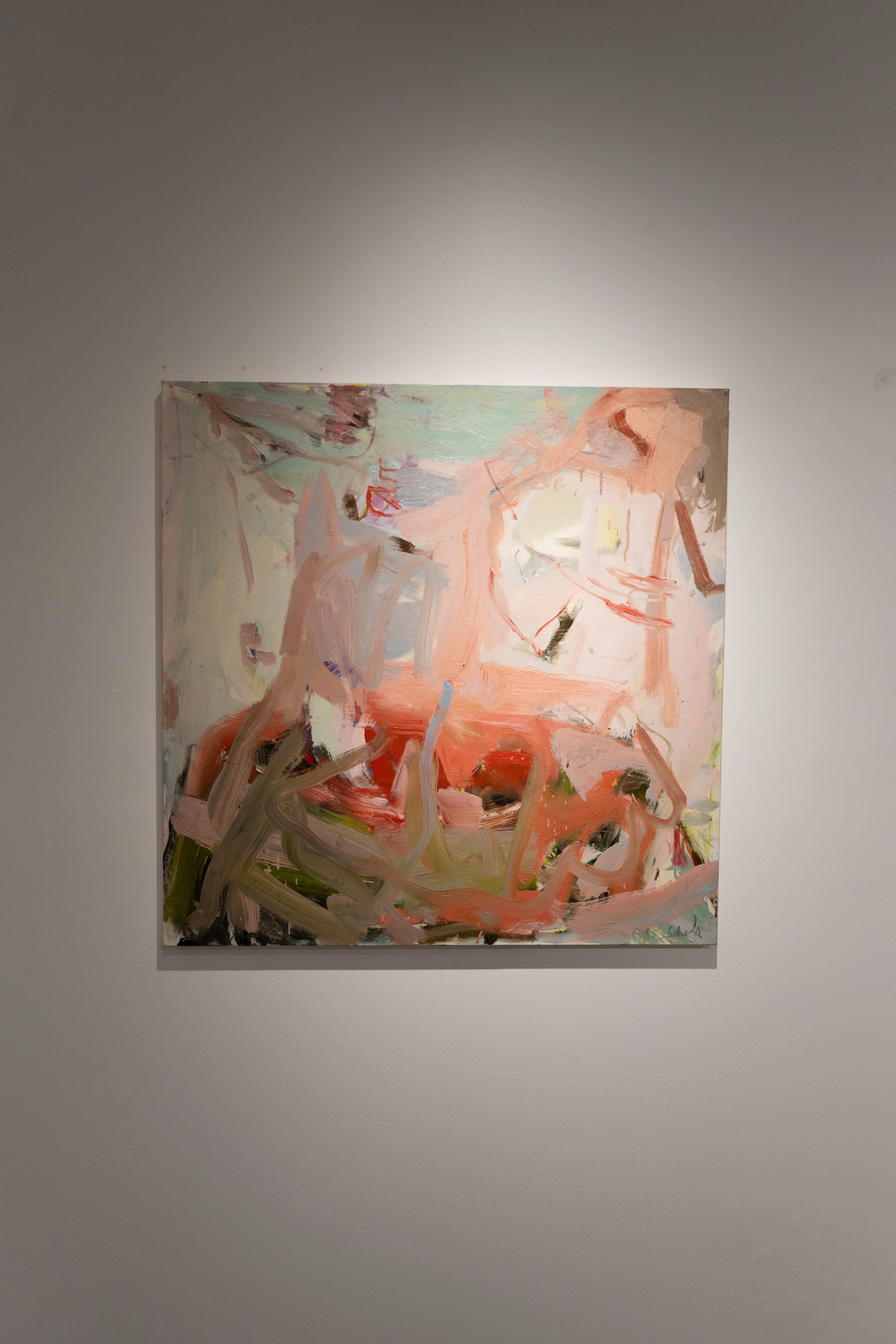
Birth of Venus, 2024. Petra Schott. Oil on canvas.
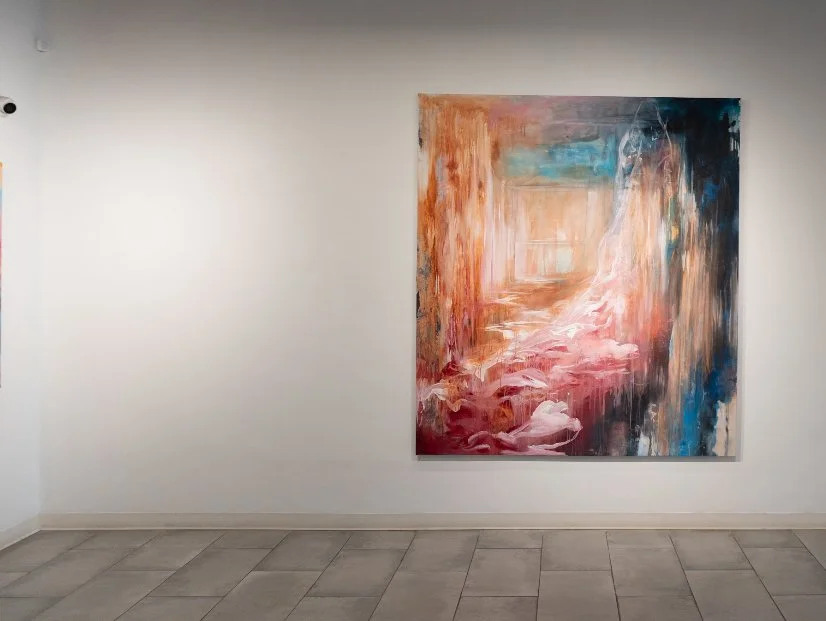
(In the Garden) I, Asphyxiate, 2025. Shantaye McMorrow. Acrylic, spray paint, graphite on canvas.
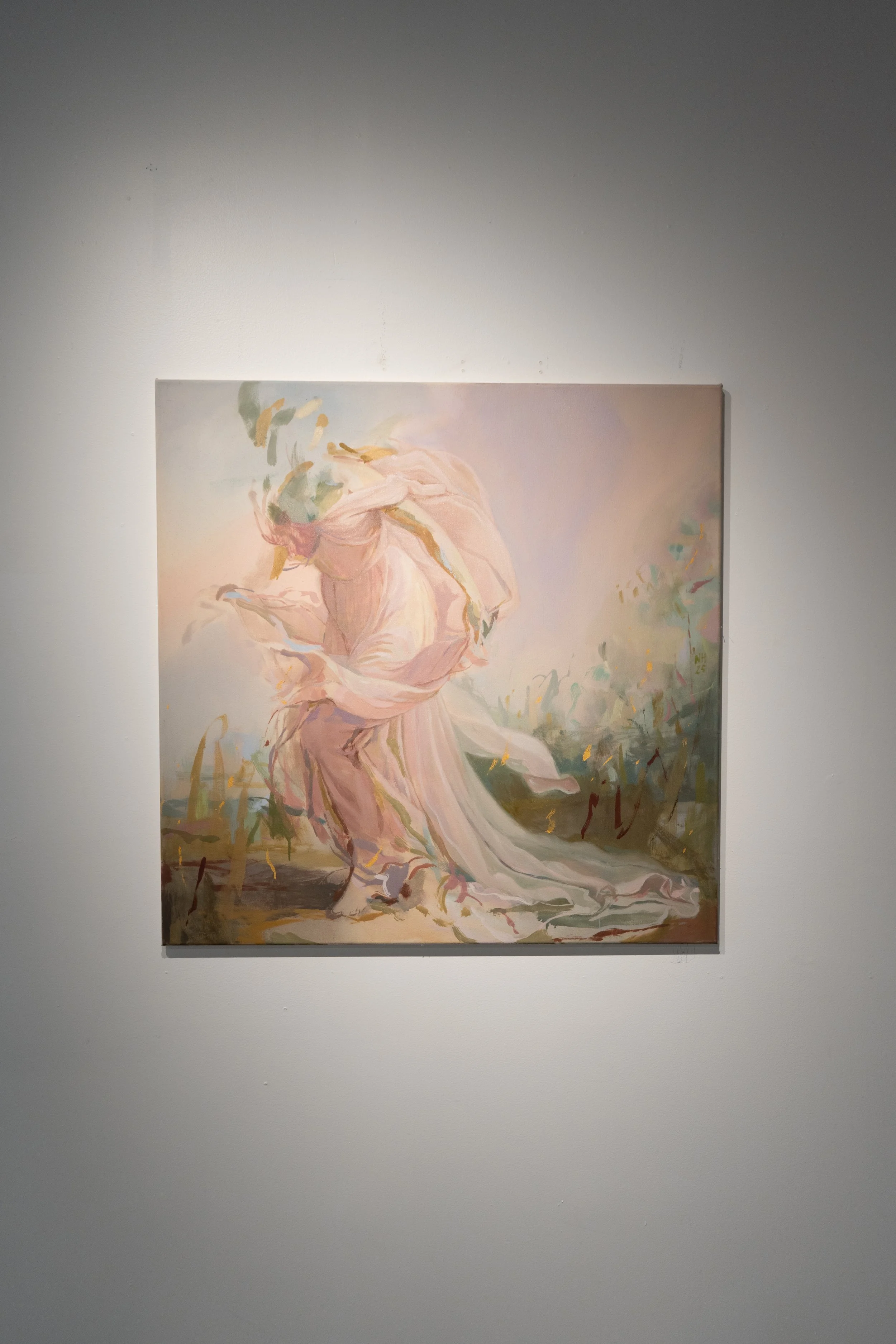
Paradise Lost, 2025. Nina Hunter. Oil, acrylic on linen.
Marco: Thank you for sitting down to discuss this whole process. I should also congratulate you on your curatorial debut. Eccentric, lovely, and a truly beautiful introduction to the art world. Let’s start with the title of the exhibition: “Roses of Heliogabalus & The Opulence of Ruin.” I know that it’s inspired by a very particular painting that you’re fond of. I want to first know about the ekphrastic nature of this curation… how it’s in conversation with that particular piece.
Aidana: I saw this painting when I was in Giverny, actually. I was on an anniversary trip that my love surprised me with. Seeing this work was a very serendipitous moment for me. The Impressionist Museum there at the time was showing the “Flower Power” exhibition. Obviously it was because Giverny is known for their gardens and whatnot. When I saw this painting, I was taken aback. I can’t even put it into words, but I felt it in my very soul and to this day it remains the most beautiful painting I’ve ever seen. Unfortunately it’s in private collection which is why it was also so serendipitous to see at the time.
Lawrence Alma-Tadema became one of my favorite artists after I saw Roses in real life. I chased him all over museums, where I would see a lot of Cy Twombly as well. These two artists in my heart go hand-in-hand. Alma-Tadema is a symbolist and is very traditional where Twombly is an abstract expressionist, but both emphasize beauty. Most of Alma-Tadema’s works are very Hellenistic in their language as they incorporate classical reference. Twombly evokes a very different feeling, but it’s still deeper and evokes other emotions.
Marco: I was actually going to ask you about the pairing of these two artists for the exhibition, as I’m aware Twombly was just as important for the curation as Alma-Tadema was.
Aidana: Twombly is a very important artist for me to mention as he is the person who inspired the sense of curation in me. He made me want to become a curator as well as a creator. I think the two are interesting to compare, both feature classical allusions but in entirely different ways.
Marco: You would say the point of convergence is classical reference and exemplification of beauty itself.
Aidana: For sure. For Alma-Tadema it’s the beauty and the subject of the painting whereas for Twombly it’s the abstract “language” used to convey those things. Abstract Expressionism is of course more modern of a language that has been growing in general appreciation, especially in New York. I feel like Mriya is a very big fan of abstract works. It feels very different when abstract works are just made to fill a space and when it has its own presence, evoking distinct feelings in the viewer. I like to think I can tell the difference between the two.
Marco: Where do you think you find the difference? Is it a definite moment that the distinction happens or more of a case by case basis?
Aidana: I think it’s a case by case basis. I understand the art world is full of esoterics, but I’m a believer in a sense. It’s very similar to religion, where you believe or you don’t. I feel like there is a difference between those two representations. I find it curious as a person who loves tradition so much in art. Symbolism is the core of what I appreciate in art because it creates this feeling of connection and lineage. Throughout the entirety of history there have been things that can be commonly recognized by anyone.
Marco: Such as the still-life.
Aidana: Yeah, and the mythology and resonance of the symbols themselves. Hellenism and classical reference have always been very fascinating to me. It’s hard to pinpoint exactly when it started. As a kid I loved Greek mythology. For the past seven years, I have had this obsession with Alexander the Great. I can’t fail to mention his influence and how centered around the classical culture I became since I started pursuing him in personal research.
Marco: I’m also very curious about the aspect of spectacle. There’s something to be said about the inherent spectacle of symbolic death, be it artistic or technological. To reference the Alma-Tadema painting, the very idea of a Roman emperor drowning his guests in a sea of flowers is also a huge political spectacle. How would you say the idea of “killing the public” with beauty is prevalent today?
Aidana: Great question. There is definitely something political to this collection, though I didn’t intend it to be. I think it’s because it does get frustrating, this culture of excess. For example, the Met Gala. Celebrities and overconsumption of glamour, perpetuated by the media and fed to the public as of this kind of desirable lifestyle. But if there’s too much opulence, it suffocates itself. I’m not a celebrity, nor have I been to the Met Gala, but I do feel that the higher you are, the more detached you can be. There is a very thin veil between privilege and gluttony. I think there is too much of an over glorification of consumption now, and excess speaks not only to the consumer but to how a lot of people in power also rely on the very same excess.
Marco: The placation offered by this overconsumption also acts as its own downfall, especially when propagated by figures in the public sphere. I’m also very curious about the artists, of course. How did you see them specifically into this important fold? Tell me about your selection process.
Aidana: So Kevin Watson was the first artist I found, about a year ago on Instagram. His ability to mix traditional conventions such as composition and theme with these jarring contexts is amazing. His whole thing is about the grotesque. He’s very tasteful about sending a message and specific about what excess can lead to. Visually his works are also stunning. Most of the artists, too, I found on Instagram. When I was offered this opportunity to curate an exhibition, I spent several weeks scrolling. I’m more than pleased with the final selection of artists, especially because I was given the job of branching out. I didn’t specifically have to stick to Ukrainian artists. Despite the position of Mriya being the first Ukrainian gallery in New York, we are always considering new avenues to branch out.
Marco: Do you think this exhibition is a departure in style for the gallery? Since its opening, it has made this deliberate emphasis on Ukrainian art and artists. Does this collection move the mission into an uncharted direction or does it still ring close to the social responsibility of the gallery?
Aidana: The gallery will always remain a Ukrainian gallery because it was founded by two Ukrainian gentlemen. It is the thing we specialize in. In the face of war, we will remain this place that gives a platform to such artists. Before this exhibition, that was just the sole identity. The way I phrase it is that this gallery has Ukrainian roots but a global outlook. You can’t have tunnel vision, especially in Tribeca. Not that specializing in particular art isn’t deep enough, but you have to understand where you want to take the space itself. You have to think about style for the collectors, so you have to be more selective. I wouldn’t say it’s a new direction because the gallery has its love of abstract artists and explorations of chaos. I think you can make that very political or touch upon it with art. I also wanted to give a platform to these young and underrepresented artists. Michael [Alexander Campbell] is an incredible artist and has been exhibited before, but he’s also very young and I wanted to highlight that.
Marco: I want to know about this aspect of chaos. Did that have any impact on your actual, physical curation of the space?
Aidana: The gallery is a great space, but it has sections. It’s not just a square, which would give it a lot of formal structure and make it easy to hang paintings. Hanging the paintings was actually very difficult, as I overestimated the spatial capacity for the works. But because there already is enough chaos in the works themselves, the job was to give space to the chaos to “breathe.” Breathing was a word we used a lot. There was one challenge of hanging up enough works, since the artists brought them specifically or made them for the exhibition, and also there was the challenge of arranging the “breath.” Abstract art certainly needs space.
Marco: Seriously. I also want to hear more about something you said at the opening, about how four of the six exhibited artists are women. They’re also from all over the world and occupy different spaces and sensibilities. Did this have anything specific to do with the actual narrative being told?
Aidana: I’d say so. I think that Gianna [Tesone] is a person who feels beauty. What makes her work her work is how sensitive she is to the traditional understanding of beauty. One of her exhibited works is “Kallos” which I believe means “beauty” in Greek. She’s the beauty aspect of this tension between beauty and violence. I’d say Nina [Hunter]’s works are also very calming and ethereal, but her painting “God’s Dream” is about Leda and the Swan. It kind of leaves this myth up to interpretation. As a woman, I feel the myth is inherently violent, you know. In one interpretation Zeus seduces Leda as the swan and in another Leda is attacked by Zeus. I believe it was Sappho who initially reframed the myth, but I can’t remember if she gave Leda agency in sleeping with Zeus or the other way around. But depending on your take of the myth, the painting can be entirely different.
Whereas Shantaye [McMorrow] brings in the chaos. In her largest work, she focuses on asphyxiation. I would say that she brings strength and fortitude to the collection. There is femininity in her works but she explores it very differently from the other artists. Petra Schott is the fourth female artist and she’s incredible. Three of her paintings center on Venus, the goddess of beauty, and one of her paintings was of Cassandra. It was very important to include this one because Cassandra is one of those women of mythology who was cursed and suffered miserably. Women’s experience in mythology is very interesting to me because most of the time it ends in tragedy. I really appreciate how a lot of artists touch on mythology in their own language simply through female experience. It brought it all together so magically.
Marco: Penultimate question. Classical allusion is very much present here, as we just spoke to. How do you think these classic elements of “mythos”, heritage and legacy readapt themselves in contemporary artists, such as these exhibited, who are very much “reaching back”?
Aidana: Hellenism is the foundation of Western culture. That is something I am very firm on. Hellenism is the time period that came right after Alexander [the Great]’s death, so it’s a time of Greek culture being adapted by other cultures. For example, we have the Renaissance. How it came to happen is because classical allusions came back into art after the whole Medieval art period where it was purely Christian and Biblical. This reintegration of mythology speaks to coming back to the ultimate and elevated approach to thinking about Man and his position in the world. What Cy Twombly said was, “To my mind, one does not put oneself in place of the past; one only adds a new link.” History is just a progression of inspiration and building on what was previously built. To me that’s the most boundless kind of inspiration, and for the art world that’s very important. At a time of constant innovation, classical reference is a safe place that grounds me so much. We’re not so removed at the end of the day. My dad says that history is a spiral. Everything echoes. We’re not that far from the past. It’s close enough to touch.
Marco: Where do you think beauty will head in the current and future climate? Do you think we’ll continue to know it as “beauty”?
Aidana: People have always found beauty in things, almost as an instinct. There’s a reason why we love picking flowers. Also, owning beauty and the desire to own it is another thing. Whether that speaks to wanting to collect art or the violence against women in terms of “ownership”, both of these things draw people to beauty and that can result in appreciation or violence. As long as there is beauty there is desire, which does speak to consumption. We consume out of desire. Something is beautiful and we think it will make us more beautiful. Our understanding of beauty in the culture of consumption is more of a philosophical question, but I do think that beauty will always remain and we will always recognize the simplest things as beautiful. I’m not nihilistic about it.
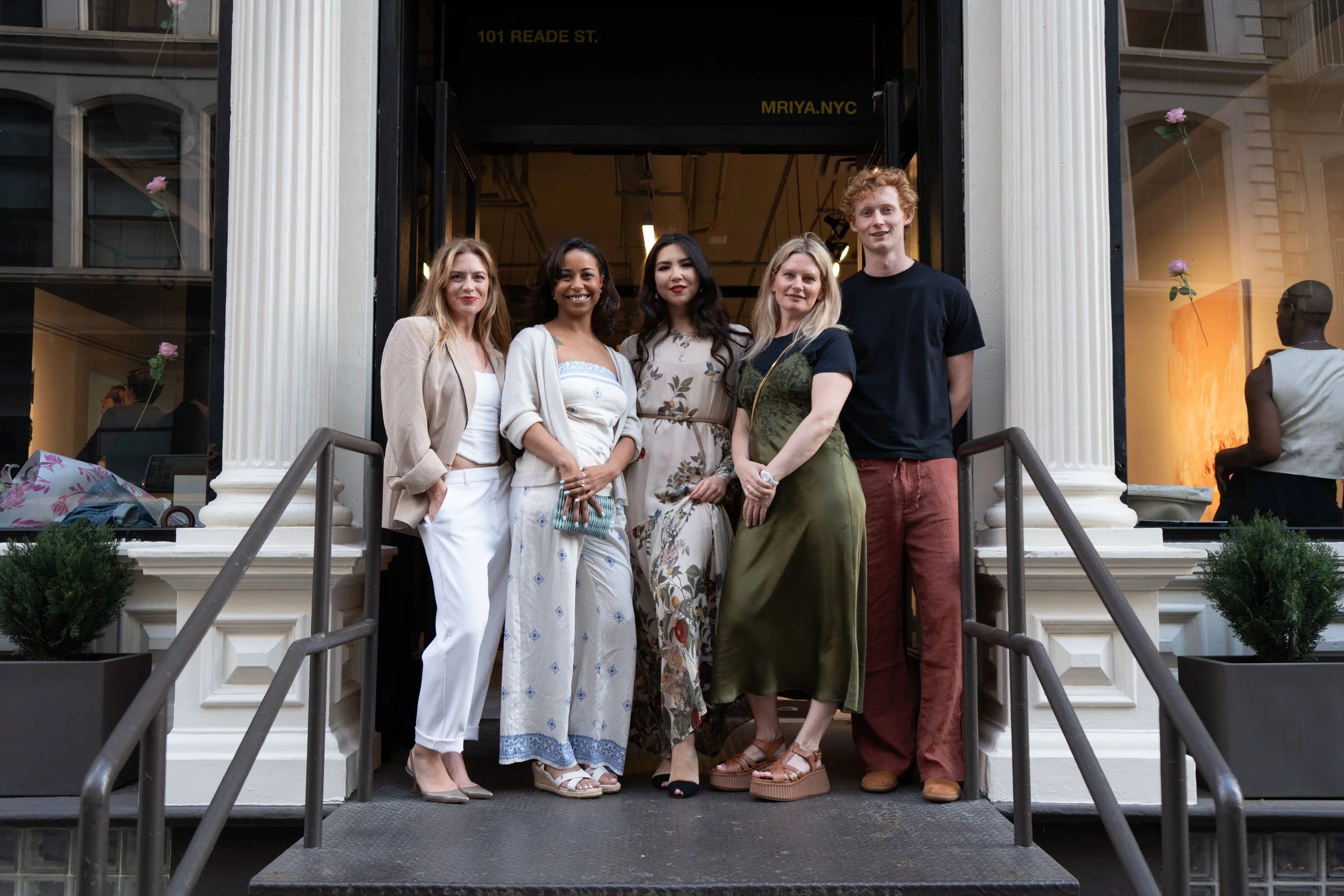
In order, from left to right, artists Gianna Tesone, Shantaye McMorrow, curator Aidana Bergali, artists Nina Hunter, Michael Alexander Campbell.
July 15, 2025