Atsushi Nishijima/Focus Features
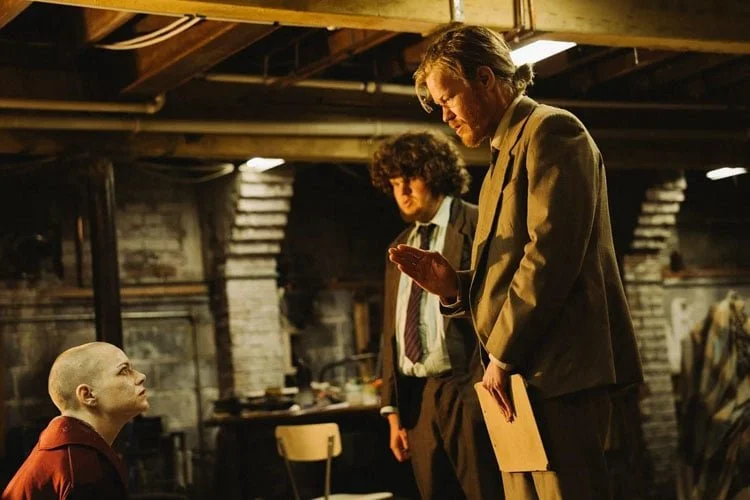
How ‘Bugonia’ Induces Psychosis
and why we want it to
by Marcello Cortese
Initially published in The New English Review

Bugonia ritual with Georgics Virgil. Lyon 1517, author unknown
I’ve dreamt of bugs recently.
Several times within the past few weeks, they’ve been there in my head. To any person who wakes up convinced that one or three might be crawling somewhere in their sheets, this would invariably be recognized as a kind of “stress dream.” I’ve wondered, too, why there have been so many so close to one another. I’m not usually prone to even remember my dreams very often. It might honestly be because of this very reason… that a person is more inclined to remember the anxious things than they are the pleasant ones. Still, they’ve been everywhere. Black beetles, stag beetles, larvae, spiders in the corners.
To me, I believe it links to the infiltration of the domestic. The anxiety around the unknown is another interpretation, I’m sure. There is something deeply unsettling about this that I believe is common enough: the disruption of the contrived life by that of the natural one. I found it funny, in a way, how these sorts of dreams struck me as anxious and fearful, just because they took place in a setting that replicated my apartment. After all, seeing a spider on a hike isn’t something that’s directly alarming. Seeing them inside the house is.
Perhaps it’s the inescapable fear of the other. The encroachment of what isn’t “normal” into our personal space. Humans have the tendency to lean toward either infatuation or repulsion when faced with something unfamiliar. The kind of tendency that has made way for what’s now become known as “abject.” This is another word that has been on my mind lately: abject. The miserable base level of living, and of moving. Existence without height.
Much of this sensibility has infiltrated the media, I’ve noticed. Gerrymandering, doomscrolling, desensitization. The messages these things develop in the unconscious are not unlike something like the effect of my bugs-in-the-house dreams. Quiet, ominous, ubiquitous. Lurking in the kitchen, feasting on dust, marching toward the dreamer… There is a fear there that has no direct purpose. It’s displaced.
The other day I went to see Yorgos Lanthimos’ newest film, Bugonia. Talk about a movie that disbands entirely with personal space. Let me start off by saying that it was one of my most anticipated of this year, as his work tends to be. Truthfully, I’m not entirely sure what I expected with regard to this work, but inevitably I got what I came for, and then a great deal extra. To briefly speak on the experience of film itself, I recall leaving the theater and thinking that it was simultaneously the most remarkable and disturbing film that I’d seen in the last five years. While it does incorporate the hallmark absurdism that Mr. Lanthimos has come to be recognized for, this film takes its subject matter far beyond that sense of tradition.
As Glen Weldon noted in his NPR review entitled, “Bugonia may or may not be about aliens; it’s definitely about alienation” the classic Lanthimos dialogue and pacing are both absent from this work. Instead, it’s closer to reality than we’ve ever seen on one of his screens, largely because of Will Tracy’s apt development of the screenplay. It comes so close that it almost touches in every way.
Weldon used the term “abject” in his review as well, which reassured me in knowing I wasn’t delving too deep into this thought. What I’m steering toward with the reference to this term and its relevance here is perhaps the most obvious talking point: the sensationalism of violence replicated in this film.
I can’t speak for the general masses, but I know that I went to see Bugonia out of love for this director and cast, not necessarily expecting the truly twisted (and very much on screen) depictions of suffering. But that’s partly the reason why the film executed itself flawlessly: this gruesome and intense drive into the more-real. It delivers, through uncanny dialogue and terrific physicalities, a character-driven story about the hopelessness of talking at one another, and not to someone. This is the primary undercurrent of dread.
Strangely enough, after ruminating on the impact this film had on me, I was reminded of Paul Thomas Anderson’s Phantom Thread in this dual ability to open and collapse the mind of the viewer simultaneously. Both have an inherent violent bite to them, tonally speaking, and even use similar techniques to explore such a bite. They champion powerful scores that shift plates deep in the soul, affronting visuals and a rapport of characters that often seems unbelievable and so close to reality that it invariably becomes more. The effect is something closer to that of the theatre than of cinema.
But this is a diversion from the larger point. Where Phantom Thread approaches the mortal and inherent evils of humans through delicately crafted policies and affectations, Bugonia rips out the middleman of social equity entirely, going right past the audience’s expectation of civility. Because, after all, the dynamic is founded upon the framework that Michelle (Emma Stone’s blue-blooded corporate CEO character) is not human. Alien. Foreign to an entire kind of existence that we (the audience) resonate with. From the very beginning of the film, this is revealed as the foundation of the struggle. Man versus existence. Man versus an existential threat. And this is what makes the rapport of the characters (and execution of violence) inherently abject. It isn’t a conversation between man and woman, it’s a dance between man and beast.
We see this on Michelle’s face in the first half of the film. After hopelessly attempting to reason with Teddy (Jesse Plemons), there is a moment of epiphany for Michelle in which she admits out loud—to both herself and Teddy—that he is truly mentally ill. That he needs help. Teddy’s reaction is predictable given what she puts in front of him so blatantly, but the moment itself is the first tonal shift in their distinction. Both her reaction and ours as the audience gives us the reassurance that this immediate plot of conspiracy is not ulterior or a masquerade. It’s the real deal for one of the major parties.
For this reason, it’s no mistake that Michelle is a woman. Unlike Jang Joon-hwan’s 2003 Save the Green Planet!, which Bugonia was based on, Emma Stone’s character is given the alien sticker as a direct response to her station as a high-powered woman. Her involvement with Teddy is the byproduct of a series of misassociations that tie her to responsibility through one thing: hierarchy. From an early point in the film, bees are revealed to be an extremely potent framework for Teddy. He keeps them in his backyard, uses them to justify his desire to dismantle this corporate scaffolding, and confronts Michelle on the basis that her work—her empire—has contributed to Colony Collapse Disorder (CCD). The direct thematic link between the narrative that Michelle is an alien queen and this ecological, spontaneous occurrence is just another nuance that is slipped into the film on the basis of subverted power structures.
Power and the penetration of security is rife in this interpretation of the film. The habitual natures of each prominent character in Bugonia are all founded on this sense of social leverage, and the loss of such is where this desperation seeps through so prominently. The desire for understanding. The sorrow of lost nostalgia. The fundamental search for goodness and rationality. The humoring of that which is not. All these funnel down and go around in a carousel throughout the film, never arriving at any kind of “conclusion.” On this basis, the film is theatrical in its success to permeate all existential levels of a viewer’s psyche.
Emotional. Rational. Political. Moral. Primal. Sensory. Psychological.
The horrific things here are born less out of the on screen shock than they are the slow, gradual evil of persuasion that Lanthimos captures. It demonstrates—in addition to the very real and very well captured societal dynamics of healthcare and human struggle in a contemporary capitalistic society—the more basic element of manipulation by something or someone that is supposed to be “trustworthy” or “safe.” The dissolution of family, of what is considered “looking out for one another,” for the sake of a personal crusade. Disposability of human life to justify the means, where there seemed to be none before. As an audience member, you have no choice but to sit and offer empathy ever so often, when it feels appropriate to. The inherent alternative is to shrink away from the danger, no matter how contrived it may be.
This is what surprised me a bit about the film itself. Lanthimos’ repertoire has developed and expanded in quite a way that by now, Bugonia is not “shocking” as a project of his. But it is surprising how he went about it. I should say that as I thought more about two most graphic moments of this film, I began to understand what was going on with those creative choices. After Poor Things was released, Lanthimos said something in an interview about how the general public has allowed for graphic depictions of gore and violence in movies and video games—all sorts of media, really—but for so long has remained prudish about sex on screen. In the past few years, this has rung less true, what with the rise of hyper-sexualization in literature, social media, film, etc. but his point at the time was an interesting one. So, knowing this, it is not difficult to understand that after that project, this was invariably what Lanthimos was building up to. While he focused on the importance of emphasizing sexuality on screen in Poor Things, he was interested in the sexualization of violence in Bugonia.
Visibility is one of these tricky things that he balances in an unexpected way here as well. In tandem with this notion of the social aptitude for explicit violence, the way Lanthimos and Tracy address the new wave of bloodlust in media is stylistically knowing. We’ve seen these extreme developments over the decades: violence amongst men in noble contexts, then violence amongst men in primal and naturalistic settings. Violence against establishment, violence against the masses, violence against women. More recently, it has become socially acceptable to even depict violence against children.
Usually, this specific trope has been addressed in ways that cushions the brutality of what is being conveyed, like through fantasy or gothicism. Movies like The Hunger Games, IT, Nosferatu, Weapons, and Terrifier are just a few mainstream examples from the past years that don’t even imply, but showcase, the brutal death of children. Even in the past weeks, with HBO’s newest hit series, IT: Welcome to Derry, there is that same subversion of expectation with regard to middle-schoolers. It’s not enough to simply imply or develop the shock of something that gruesome, it is now being displayed for all to see. Audiences accept it as thrilling, too. Even exciting. It’s the newest, most unused taboo that is unaddressed territory, so whoever is at the forefront of such a movement is holding the attention of the masses.
What might this hint at? Perhaps the collective and unspoken truth that no one and nothing is truly “safe” anymore. Not the innocents, not the nurturers, nothing associated with the “domestic” any longer. This is inherently done through dissociation and desensitization.
“Well, they’re not real people.”
“Well, it’s just a story. It didn’t actually happen.”
Except it did. It does. It’s why pieces of fiction are written and directed and developed about these topics. They often provide channels into these kinds of themes without having to confront a member of the audience so vehemently. And yet, that insatiate need of the hordes demands that the confrontation comes. It thrills and repulses, like watching a car crash. It brings a person close to truly feeling the unadulterated consequence of “something.” It might very well be the wrong thing to feel, but it is a feeling nonetheless.
What I will say about Bugonia’s approach to all these things is that it uses these undercurrents of social dread and topical exposure to its advantage, not destitution. I should also clarify that there are no dead children in Bugonia, thankfully, but that hyperbolic sense of violence is still present. Unlike some of the aforementioned movies, this one—regardless of what a viewer may be left with emotionally—includes its violence to execute a point. A gruesome and affronting point, but it is still intentional. There isn’t a sense of flippant or careless “torture porn” as with other depictions. Nevertheless, I found it interesting enough that the gore was left full front and center on screen, whereas the torture was panned away from.
I’ll leave out the detailed and specific example I was aiming to use for this point, as it is both a spoiler and only elongates the (already long and arduous) points I just made above.
Nevertheless, what Bugonia is with regard to the title of this piece is a threshold. A new one that shows us, as a social order, what the new “status quo” is; where the boundaries have been pushed back to. What is brilliant and what is grotesque. It does this by walking through itself as a recognition of both natural and contrived order. It proves to a viewer, even in the deep dark part of a person that may seem malicious or manipulative, that within a social blend of order, development and progress, only chaos is truly able to form that perfect “spiral” that so many fall privy to. It is in destabilization that a reset happens, that a new development comes into play, that a reckoning takes place on a large, vast scale.
Even to the point of my dreams about bugs (which the word “bugonia” has a fascinating relevance to this matter), the film takes a morbid comfort in the inevitable and inescapable. Infiltrations happen, they just do. Nothing in life is hermetically sealed and things are often left entirely up to spontaneity or the unknown. And this, because of the common lust for reason or explanation, will continue to be the rhyme of life.
In the hands of any other director, this project would have been irresponsible and harrowing. Given that it was sprinkled and stamped by Lanthimos’ unique touch, however, it hits the mark in exactly the places it aims for. To some, Bugonia will be a film that manifests as a fever dream: tumultuous in its subject matter but somehow perfectly executed in its nuance and technicality, without offering any justification for the series of moments it offers you. To others, it will seem hyper-centralized and perhaps distinctly “woke.” Regardless, it will remain, undoubtedly so, outside of both reality and fiction for its ability to devour and excrete both.
Jan. 17, 2026
Initially published in The New English Review